The Man Who Turned Advertising Into a Science
Claude C. Hopkins (1866–1932) is widely regarded as one of the most influential figures in the history of advertising.
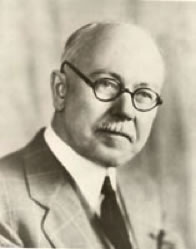
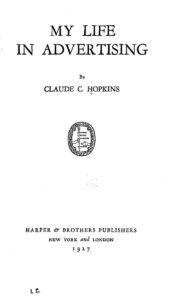
In his autobiography, My Life in Advertising, Hopkins describes a childhood shaped by discipline, religion, and strict moral standards. Raised in a deeply religious household, he was trained early in persuasion — not in commerce, but in conviction. His early experiences selling religious books door-to-door became his first laboratory in human psychology.
Those formative years taught him lessons that would define his career:
- People respond to sincerity.
- Claims require proof.
- Specificity outperforms generality.
- Results matter more than opinions.
Long before entering an agency, Hopkins was already testing what moved people to act.
The Birth of “Scientific” Advertising
Hopkins began his professional career writing ads for patent medicines and mail-order companies, where measurable results were essential. Unlike brand advertisers of his era, mail-order marketers had to know exactly which advertisements paid for themselves.
This environment shaped his philosophy.
He rejected guesswork.
He rejected creativity for its own sake.
He rejected awards and applause.
Instead, he insisted on testing, tracking, and measurable return.
His ideas later became crystallized in Scientific Advertising, where he argued that advertising should be governed by principles as reliable as those in engineering or medicine.
He wrote:
“Advertising is salesmanship multiplied.”
To Hopkins, an advertisement was not art.
It was a salesman — just one that spoke to thousands at once.
Major Campaigns and Achievements
During his career, Hopkins helped build and expand some of the most recognized brands of his time, including:
- Pepsodent
- Schlitz Beer
- Palmolive
- Quaker Oats
- Sunkist
- Kotex
In My Life in Advertising, he recounts how many of these campaigns succeeded not through flashy slogans, but through disciplined reasoning.
For example:
- He popularized the concept of explaining a product’s process (as with Schlitz Beer’s “pure” brewing methods).
- He transformed Pepsodent by introducing the idea of removing “film” from teeth — a problem most consumers didn’t know they had.
- He relied heavily on coupons and sampling, believing that “try before you buy” was one of the strongest forms of proof.
Every campaign was built on the same foundation:
identify a specific benefit, prove it, remove risk, and measure the response.
His Philosophy of Restraint
One of the most striking aspects of Hopkins’ autobiography is his resistance to ego.
He repeatedly emphasized that advertising was not about cleverness.
It was about service.
He discouraged exaggeration.
He opposed vague claims.
He insisted that good advertising should read like helpful information.
In his own words, he did not consider himself creative — he considered himself practical.
That restraint became one of his greatest strengths.
Why His Work Still Matters
Hopkins retired at the height of his success, financially secure and confident that the principles he had outlined would endure.
Nearly a century later, they have.
Modern tools may change — digital platforms, email funnels, social media — but the psychological forces Hopkins studied remain constant:
- Motivation
- Proof
- Risk reduction
- Specificity
- Testing
His work continues to influence copywriters, marketers, and entrepreneurs worldwide.
A Legacy of Measured Persuasion
Claude Hopkins did not seek fame.
He sought effectiveness.
Through disciplined testing and practical reasoning, he helped transform advertising from speculation into a measurable profession.
In doing so, he left behind more than campaigns.
He left behind a way of thinking.
And for serious students of persuasion, that way of thinking remains as relevant today as it was in the early twentieth century.